


Best Conveyor Sensors for Eggs
- bay7962
- 6 days ago
- 6 min read
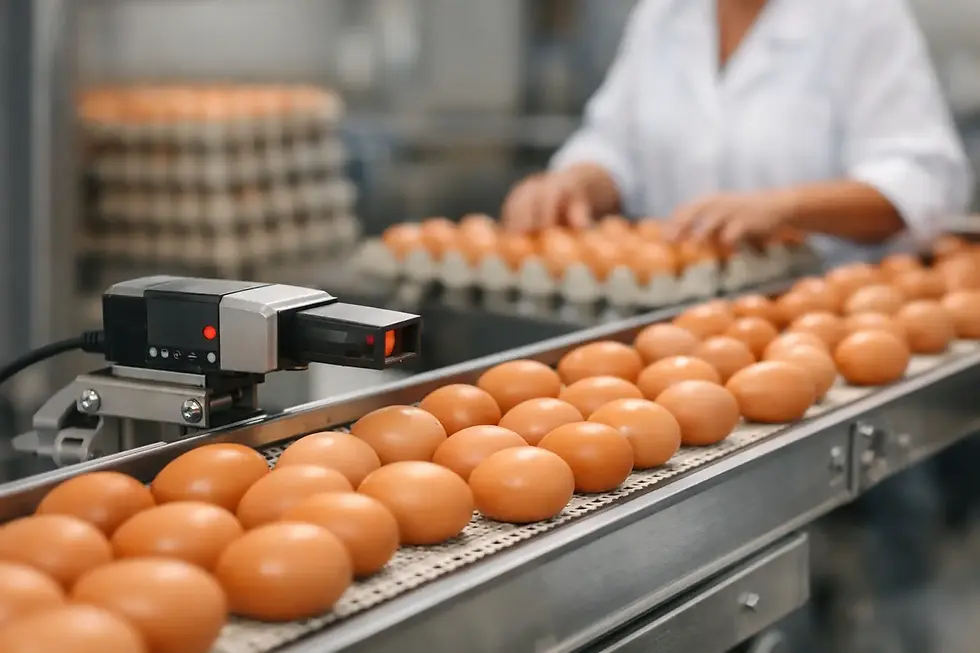
Missed counts on an egg belt rarely come from the belt itself. The problem is usually sensor fit, sensor geometry, or a device being asked to work outside the conveyor conditions it was built for. When producers ask about the best conveyor sensors for eggs, the right answer starts with the line - belt width, egg density, speed, spacing, dust load, and the output needed by the rest of the system.
Egg handling is a narrow application, and that matters. General photoelectric sensors can detect presence, but they are not automatically suitable for accurate per-egg counting on moving collection belts. In a commercial house, the requirement is not simply to see product. It is to register each egg consistently, across changing flow conditions, without slowing production or creating a maintenance burden.
What makes the best conveyor sensors for eggs
The best conveyor sensors for eggs are purpose-built counting sensors designed for the shape, spacing and movement of eggs on a collection line. That usually means infra-red detection arranged to read eggs across the usable belt area rather than relying on a single point sensor trying to infer count from interruptions.
For most producers, accuracy under live production conditions matters more than headline sensor sensitivity. Eggs do not arrive as perfectly spaced units. They can travel in groups, drift laterally, rotate, or momentarily touch. A sensor that performs well on a tidy demonstration rig may lose reliability when the belt is carrying mixed flow from several rows.
This is why two-dimensional detection has a clear advantage in egg counting. Instead of depending on one beam or a narrow sensing zone, it observes movement across an area. That reduces the chance of missed counts when eggs are close together and helps maintain stable output on wider conveyors.
A second requirement is a clean pulse output. Production managers and integrators often need each counted egg to generate a distinct signal for downstream counters, PLCs or farm management systems. If the output is unstable, delayed, or poorly defined, the count may drift even when the sensor itself appears to be reading correctly.
Why standard conveyor sensors often fall short
Many facilities begin by considering standard photo-eyes, diffuse sensors, or through-beam units because they are familiar and readily available. These devices have a place in industrial conveying, but egg belts present a specific counting problem.
A single-beam sensor can work where eggs are highly controlled and pass one by one through a fixed path. That is not how most egg collection systems operate. On real belts, eggs may overlap from the sensor's perspective, pass offset from the ideal centre line, or create inconsistent interruptions depending on shell orientation and ambient contamination.
Diffuse sensing is especially variable because shell reflectivity changes with dirt, dust and lighting conditions. Through-beam systems are more stable, but one beam still gives a limited picture. On narrow belts with disciplined product flow, that may be acceptable. On wider belts or denser loading, it usually is not.
The trade-off is straightforward. Simpler sensors may have a lower purchase cost, but they can cost more in lost confidence, manual reconciliation and avoidable production reporting errors.
Sensor types used on egg conveyors
In practice, egg conveyors are best served by a small number of sensor approaches. The first is the standard industrial presence sensor, used mainly for jam detection or occupancy checks rather than precise counting. It is suitable for confirming that eggs are moving, but not ideal where exact totals are required.
The second is a single-line counting sensor. This can be effective on narrow conveyors with predictable egg presentation. If the line is controlled and throughput is moderate, it may deliver usable counts. Its limitation appears when eggs bunch together or use more of the belt width than the sensing line can reliably interpret.
The third, and generally the strongest option, is a dedicated two-dimensional infra-red egg counter. This design is built specifically for eggs moving on collection belts and conveyors. It is better suited to commercial production because it addresses the actual geometry of the product and the conveyor, not a simplified version of it.
Choosing by conveyor width, not only by sensitivity
One of the most common buying errors is comparing sensors by advertised sensitivity while ignoring belt width. Width is a primary selection factor because the sensor must cover the working area properly.
A narrow belt can often be handled by a compact unit designed for that footprint. On the other hand, larger egg collection systems require counters sized to match wider conveyors. If the sensor is undersized, eggs travelling near the edges may be counted inconsistently. If it is oversized without proper installation, alignment can become more difficult than necessary.
This is where a dedicated product range matters. A practical example is a system with a model for 10 cm conveyors and additional models covering widths from 20 cm up to 100 cm. That gives equipment buyers a more precise fit to the line rather than forcing one sensor format onto every application.
Output requirements matter as much as detection
The best conveyor sensors for eggs do not stop at seeing eggs. They must communicate counts in a way the site can use immediately. For some farms, that means a per-egg pulse output into an existing counter. For others, it means integration with a control cabinet, data logger or production monitoring platform.
A clean pulse per egg is especially useful because it keeps system architecture simple. Maintenance teams can trace signals more easily, and production staff can compare conveyor totals against packing or flock data without adding unnecessary interpretation layers.
Power supply and output characteristics also need checking early. A sensor may be accurate, but if it does not match site voltage, input type, or control logic, installation becomes more complicated than it should be. For production facilities, compatibility is not a secondary detail. It is part of sensor performance.
Installation is part of counting accuracy
Even a good counter will underperform if it is mounted badly. Height above the belt, angle, belt tracking, vibration, and surrounding structure all influence results. On egg conveyors, small installation errors can create repeatable count drift that looks like a product issue when it is actually a mounting issue.
The best suppliers recognise this and provide installation guidance with the hardware. That is particularly important on older houses where conveyor layouts are not identical from one shed to the next. Correct placement reduces false counts, stabilises output, and shortens commissioning time.
Dust, feather debris and washdown conditions should also be considered. A sensor that is difficult to clean or prone to contamination at the sensing face will demand more maintenance attention. Producers should not assume that a more sensitive device is better if that sensitivity makes it less tolerant of normal farm conditions.
When a specialist egg counter is the better choice
For most commercial producers, the strongest choice is a specialist egg counting sensor rather than a general industrial sensor adapted for the job. The reason is simple: egg belts are not generic conveyors, and the counting requirement is not generic detection.
A purpose-built system such as a patented two-dimensional infra-red counter is designed around per-egg accuracy on moving collection belts. That includes the sensing arrangement, the count output, and the model sizing for different conveyor widths. In operational terms, that means less compromise.
Agro System's Accucount range is an example of this specialist approach. The Mark 5 is intended for 10 cm conveyors, while the N series covers wider formats from 20 cm to 100 cm. For buyers comparing options, that sort of width-specific coverage is more useful than broad marketing claims because it directly affects whether the sensor fits the line properly.
How to decide what is best for your site
If the line is narrow, egg spacing is controlled, and count data is used mainly for local indication, a simpler counter may be enough. If the site runs multiple belts, wider conveyors, or needs dependable production totals for management decisions, a dedicated two-dimensional egg counter is usually the better investment.
It also depends on the cost of being wrong. On a low-volume line, occasional manual reconciliation may be acceptable. On a high-throughput farm where counts feed labour planning, flock performance review, or dispatch decisions, poor sensor choice can create ongoing operational noise.
Buyers should evaluate three things first: conveyor width, expected egg presentation on the belt, and the required output into the existing system. Once those are clear, the shortlist usually becomes much smaller and more practical.
The best sensor is not the one with the longest specification sheet. It is the one that counts eggs accurately on your belt, fits the conveyor width, and provides a dependable signal day after day. If you start with those criteria, you will make a better decision than by comparing general-purpose sensors that were never designed for egg collection work in the first place.
When count accuracy affects production control, choose hardware that treats egg counting as a primary job rather than a side use for a standard conveyor sensor.


Comments