


Egg Counting Hardware Versus Manual Tallying
- bay7962
- 2 days ago
- 6 min read
A belt running full at morning peak does not wait for a clipboard. In commercial production, egg counting hardware versus manual tallying is not a theoretical comparison. It affects line visibility, labour use, flock reporting, grading flow and the confidence behind every production figure recorded during the day.
Manual counting still has a place in some houses, particularly where throughput is low, automation is limited or a temporary check is needed. But once eggs are moving continuously on belts and conveyors, the method used to count them starts to matter as much as the count itself. The practical question is not whether staff can count eggs. It is whether they can do it consistently, at production speed, across every shift, without creating delay or uncertainty.
Egg counting hardware versus manual tallying in practice
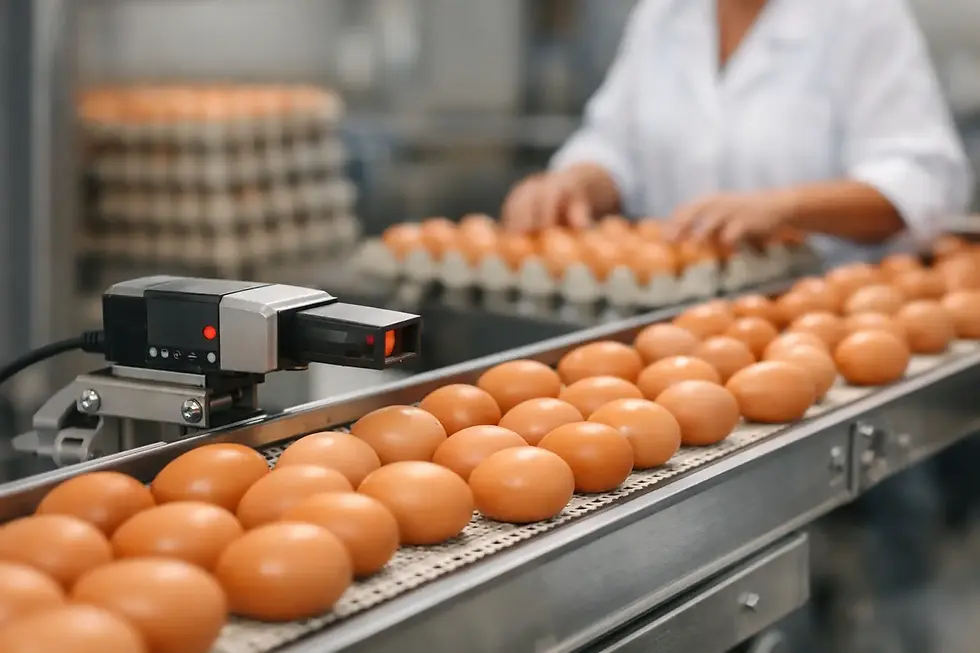
The main difference is simple. Manual tallying depends on people observing flow, grouping eggs visually and recording totals by hand or into a separate system. Egg counting hardware measures each egg as it passes the sensing point and sends a pulse output for every count event.
That distinction changes the quality of the information available to the farm. A manual count is usually periodic, approximate or delayed. Hardware counting is continuous and tied to the actual movement of eggs on the conveyor. On a modern collection line, that is a major operational difference.
Where egg flow is steady and modest, a trained operator may achieve acceptable manual figures for short periods. Where multiple belts, variable belt loading and long collection windows are involved, manual methods become harder to trust. Counting fatigue, distraction, shift changes and simple recording errors all affect the result.
Accuracy under production conditions
Accuracy is usually the first reason producers move away from manual tallying. Not because staff are careless, but because production conditions are not static. Eggs may arrive in clusters, spacing may vary, shell colour may differ by flock, and belt speed may not be perfectly uniform.
A person counting by sight has to make repeated judgement calls. Did three eggs just pass or four? Was that double-stacked moment seen correctly? Was a partial tray count carried over accurately after an interruption? Those small errors compound over a full house and a full day.
Purpose-built counting hardware is designed to remove that judgement from the process. In a properly installed system, the sensor reads eggs passing through the defined counting area and produces a per-egg signal. That gives production staff a direct count from the line rather than an estimate derived from observation.
This does not mean hardware is infallible in every setting. Installation position, conveyor width, product spacing and general line condition still matter. A good counting result depends on equipment being matched to the belt and installed correctly. But when the system is sized and fitted for the application, hardware gives a more dependable basis for production reporting than a manual tally sheet.
Where manual counting breaks down first
Manual methods usually fail first at the points operators already know well: peak collection periods, staff handovers, busy multi-tasking windows and lines where one person is expected to watch more than one process at once. In those conditions, counting competes with other jobs. Once attention is split, accuracy falls.
That problem is magnified in larger houses. A method that is manageable on a narrow belt can become unrealistic on wider conveyors carrying a heavier and less evenly spaced flow.
Labour use and operational discipline
Manual tallying is often treated as low-cost because it does not require capital equipment. In practice, it shifts cost into labour time, supervision and reconciliation. Somebody has to do the counting, record the figure, pass it on and check whether it aligns with expected output.
That may be acceptable for occasional verification. It is less attractive as a routine production control method. Labour assigned to watching belts is labour not assigned elsewhere. On farms already managing staffing pressure, repeated manual counting adds work without improving the line itself.
Hardware changes that equation. Once fitted, it counts continuously without requiring a person to stand with the conveyor. Staff can focus on collection performance, equipment condition, egg handling and exceptions rather than basic enumeration.
There is also a discipline benefit. Manual systems rely on people following the same method every time. Even good teams develop variation between shifts. One operator may count by batch, another by elapsed time, another by tray conversion. Hardware standardises the count source.
Data quality, not just total numbers
For many buyers, the issue is not only getting a daily total. It is getting a count that can be trusted for operational decisions. Feed conversion review, flock performance checks, grading reconciliation and dispatch planning all improve when the base count is consistent.
Manual tallying often creates lag between production and reporting. Numbers may be written down and entered later, sometimes after corrections or interpretation. That weakens traceability. If a figure looks wrong, it can be difficult to identify whether the issue came from the line, the observer or the later transcription.
Hardware counting gives a cleaner starting point. Each egg produces an output event at the moment it passes the sensor. That is a more useful signal for integration with counters, controllers or farm management tools. It supports live monitoring rather than after-the-fact reconstruction.
For sites trying to compare house performance or track collection trends over time, this consistency matters more than many expect. Better count discipline usually improves confidence in the wider production record.
Hardware fit on conveyors matters
Not all egg collection systems present the same counting challenge. Conveyor width, mounting constraints and egg presentation all affect what should be installed. This is one area where dedicated equipment has a clear advantage over improvised counting approaches.
A production site with a narrow 10 cm conveyor has different requirements from a line handling 20 cm, 50 cm or 100 cm belt widths. The counting device must suit the physical path of the eggs and the expected throughput. If the hardware is too narrow, poorly positioned or mismatched to the conveyor arrangement, performance will suffer.
That is why product range and installation guidance are not minor details. A specialist supplier such as Agro System focuses on egg counting as a defined engineering problem, with models built for different conveyor formats and a patented sensing approach intended for production belts rather than laboratory conditions.
Installation is part of counting performance
A fair comparison between egg counting hardware versus manual tallying has to include installation quality. A badly installed counter can create avoidable problems, just as a poorly supervised manual process can. The difference is that hardware performance can be engineered and repeated.
Mounting height, alignment, electrical supply and signal handling should all be set to the application. Once those basics are correct, the system can provide stable output over long operating periods with minimal operator involvement.
When manual tallying still makes sense
There are cases where manual counting remains reasonable. Smaller operations with limited automation, short seasonal runs or temporary validation work may not need a permanent counter at every point. Manual checks can also be useful when commissioning a line or investigating an anomaly.
But that is different from relying on manual tallying as the primary count method in a commercial automated environment. The larger and faster the system, the weaker that approach becomes. What works as a stopgap rarely works as a control standard.
The decision is partly about scale, but not only scale. It is also about how much certainty the business requires. If the count is used merely as a rough reference, manual methods may be tolerated. If the count drives management decisions, staffing choices or equipment planning, tolerance for uncertainty is lower.
Cost should be judged over time
The cheapest method on day one is not always the least expensive over a year. Manual tallying avoids purchase cost, but it carries hidden losses in labour hours, reporting inconsistency and avoidable discrepancy checks. Those losses are easy to overlook because they are spread across ordinary daily work.
Hardware requires upfront investment, yet it can reduce repeated manual intervention and improve confidence in output data from the first day of use. For commercial producers, that usually makes more sense than relying on a counting method that becomes less reliable as line speed and egg volume rise.
The practical threshold is straightforward. When eggs are moving continuously on conveyors and the business needs dependable figures without tying up staff, dedicated counting hardware is the stronger option. Manual tallying can still support spot checks and low-volume tasks, but it is not a substitute for purpose-built line counting on a production farm.
The useful question is not whether people can count eggs. It is whether the counting method matches the scale, speed and discipline of the operation you are running.


Comments