

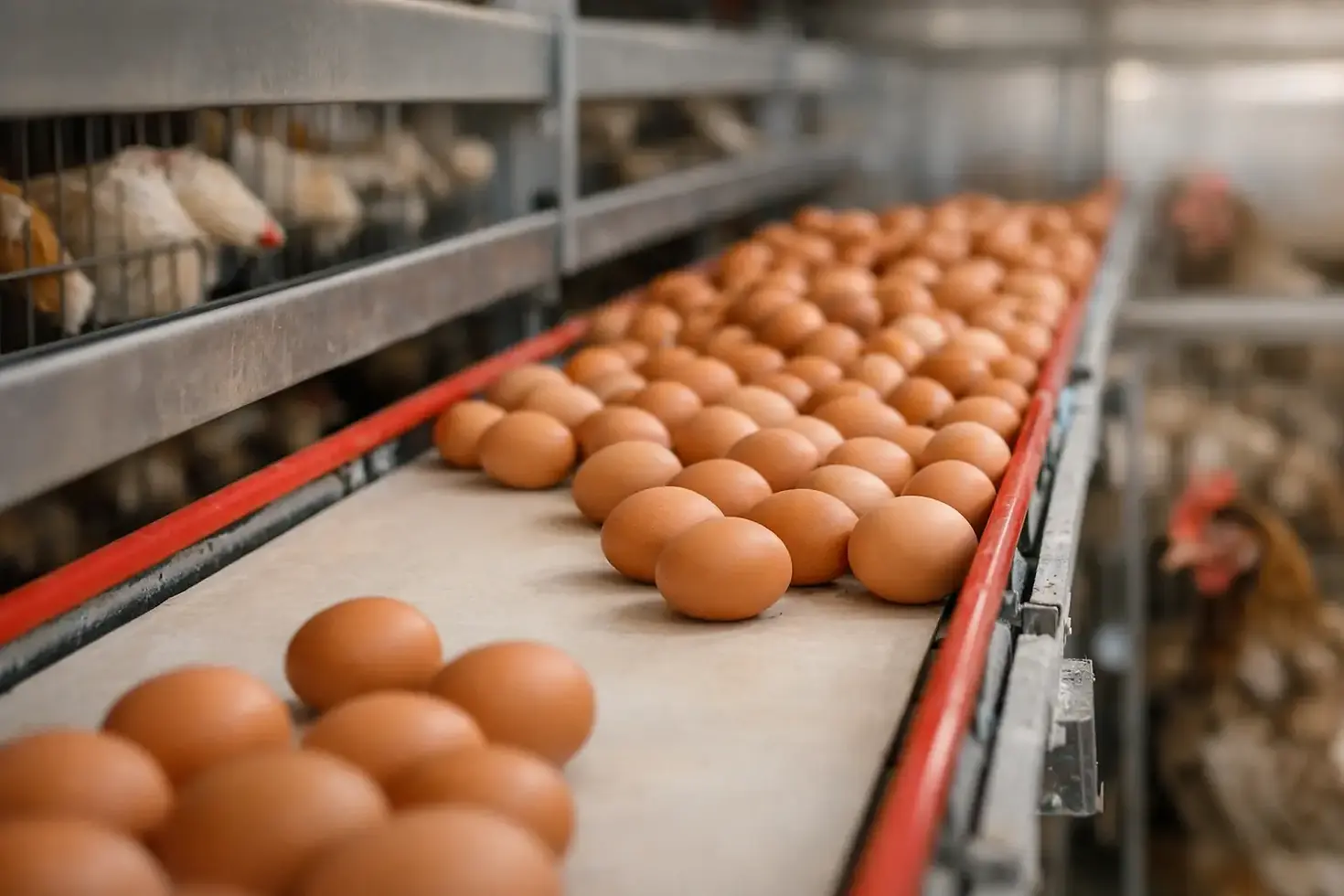
Egg Flow Bottleneck Analysis on Collection Belts
- bay7962
- 7 days ago
- 6 min read
A belt that appears to be running normally can still be restricting egg flow. Eggs may queue briefly at a transfer, spread unevenly across a wide conveyor, or arrive at the packer in batches rather than at a steady rate. Egg flow bottleneck analysis turns these observations into measurable evidence, allowing production teams to identify where collection capacity is being lost and whether the restriction is mechanical, operational or related to monitoring.
The objective is not simply to find the slowest belt. A useful analysis identifies the point where egg movement becomes constrained, measures the effect on throughput, and confirms whether the count data reflects the eggs actually passing that point. This matters when several house belts feed a shared cross conveyor, lift or transfer section. A small delay upstream can become a significant restriction when production is high.
What Egg Flow Bottleneck Analysis Measures
Egg flow bottleneck analysis compares the movement of eggs through each stage of the collection route. The key question is straightforward: does each section accept and discharge eggs at the rate required by the section before it?
Start with throughput, expressed as eggs per minute or per hour. Compare the count at the inlet of a section with the count at its outlet over the same time period. A lower outlet rate does not automatically mean eggs are missing. They may be accumulating on the belt, held at a transfer, or still travelling between measurement points. The trend over time is more useful than a single total.
The analysis should also consider belt speed, usable belt width, egg spacing and operating time. A narrow belt running at a suitable speed may carry more consistently than a wider belt with poor distribution. Likewise, a high-speed belt can create collisions and roll-back at a transfer if the receiving conveyor is slower or positioned incorrectly.
A bottleneck normally reveals itself through one or more of the following conditions:
growing egg accumulation before a transfer or lift;
repeated gaps followed by dense groups of eggs;
a mismatch between upstream and downstream count rates;
staff intervention to clear eggs, straighten belts or prevent pile-ups; and
reduced collection performance during peak lay periods.
These conditions should be recorded against time of day and flock production. A line that performs well during low output may have insufficient capacity during the main collection window.
Map the Collection Route Before Changing Equipment
A reliable assessment begins with a physical map of the egg route. Include all house belts, cross conveyors, elevators, diverters, accumulation areas, counters and packer infeed points. Note the direction of travel, belt widths, approximate speeds and the position of each transfer.
This exercise often exposes assumptions. For example, two house belts may feed one cross belt, but not at the same time or at the same position. The combined theoretical capacity may be acceptable, while the actual loading pattern creates a short, concentrated surge that overwhelms the next transfer.
Measure each belt section rather than relying on nominal machine settings. Belt speed can change with wear, drive condition, loading and adjustment. Check whether belts run centrally, whether side guides create pinch points, and whether the receiving belt has enough clear space to accept eggs without contact.
It is also worth recording planned stops. A collection line may be sized correctly when operating continuously but become constrained by frequent short stops for adjustment, egg removal or packer interruptions. Those lost minutes are often more significant than a modest difference in belt speed.
Separate a Flow Restriction From a Counting Problem
Count data is valuable only when it is interpreted alongside what is happening on the conveyor. If an upstream counter records more eggs than a downstream counter, there are several possible explanations: eggs may be held between counters, eggs may be bypassing the measurement point, or one counter may not be detecting every passing egg.
Do not treat a count mismatch as a counter fault without checking the flow path first. Examine the area between the two devices for accumulation, double lanes, roll-back, egg overlap and side movement. Eggs that travel in an uncontrolled pattern are harder to compare between stations, particularly where wide conveyors merge into narrower sections.
A correctly installed two-dimensional infra-red counter provides a per-egg pulse output that can be compared with belt operation and production records. On a stable section of conveyor, this creates a useful time-based record of flow. If the pulse rate drops while eggs visibly build up upstream, the restriction is likely before or at the counting point. If the belt remains clear but the recorded count becomes irregular, inspect sensor alignment, mounting position, electrical connections and the condition of the passing area.
Accucount equipment is intended for this type of production monitoring, with models selected to suit conveyor width. Correct sizing is not a minor installation detail. A counter must cover the active egg path, not merely the nominal frame width of the conveyor.
Inspect Transfers Where Capacity Is Usually Lost
Transfers are the most common location for a bottleneck because they change the eggs' speed, direction or available space. The following checks are practical during a normal collection run.
Match the Receiving Capacity
The receiving belt must move eggs away at least as quickly as they arrive. Where two or more belts feed a common conveyor, assess the combined peak rate rather than the average rate. A cross belt may cope for most of the day and still back up when several rows deliver at once.
Speed alone is not the answer. Increasing the speed of a receiving belt may improve clearance, but it can also increase egg movement, collisions and instability. The aim is controlled transport with sufficient separation, not the highest possible belt speed.
Check Height, Gap and Alignment
A transfer gap that is too wide, too high or poorly aligned causes eggs to hesitate, strike an edge or turn sideways. Those small interruptions reduce the usable capacity of the belt. Look for eggs that pause at the handover point, rotate repeatedly or collect against guides.
Inspect transfer components for worn brushes, damaged rollers, loose guides and contamination. A belt that tracks to one side can narrow the usable carrying area and force eggs into a tighter stream. The resulting congestion may be intermittent, which is why inspection should take place while the line is loaded.
Identify Uneven Loading Across Wide Belts
On wide conveyors, eggs rarely occupy the full width evenly without suitable delivery arrangements. If most eggs run in one lane, the practical capacity may be far below the theoretical capacity of the belt. Uneven loading also affects monitoring because the counter must be positioned and sized for the real egg path.
Watch the belt from above where possible. If eggs are consistently concentrated near one edge, trace the cause upstream. It may be a discharge chute, guide arrangement, belt tracking issue or a transfer that introduces eggs at an angle.
Use Time-Based Counts to Locate the Restriction
Totals at the end of the day are useful for production reporting but are too coarse for fault finding. For bottleneck work, compare counts in short, repeatable intervals, such as five or fifteen minutes, while noting line status.
A simple record should include the upstream count, downstream count, belt running condition, visible accumulation and any intervention. Over several collection cycles, patterns become clear. A consistent delay after a particular house belt starts, for example, points to a capacity issue at the merge. A sudden reduction after cleaning or maintenance may point to a changed guide position or sensor installation condition.
Where the counting system feeds a farm-management input, retain the raw pulse-based data where possible. It provides a clearer indication of changes in egg flow than manually entered totals. The data does not replace physical inspection, but it directs attention to the period and section that need inspection.
Correct One Constraint and Prove the Result
Make one controlled change at a time. Adjusting belt speed, transfer geometry, guides and counter position together may improve the line, but it prevents the team from knowing which change solved the problem. Record the original condition, the adjustment made and the count rate before and after the work.
After a change, run the line during a period that represents normal peak loading. Confirm that accumulation has reduced, transfer behaviour is stable and downstream count rates follow upstream flow with only the expected travel delay. Also confirm that the change has not created a new restriction further along the route.
The most useful outcome is not a one-off improvement in belt appearance. It is a collection route where egg flow remains controlled at peak production, count signals remain credible, and maintenance teams know which measurements will identify the next developing restriction before it becomes a stoppage.


Comments