


Egg Production Monitoring Systems That Count
- bay7962
- Apr 22
- 6 min read
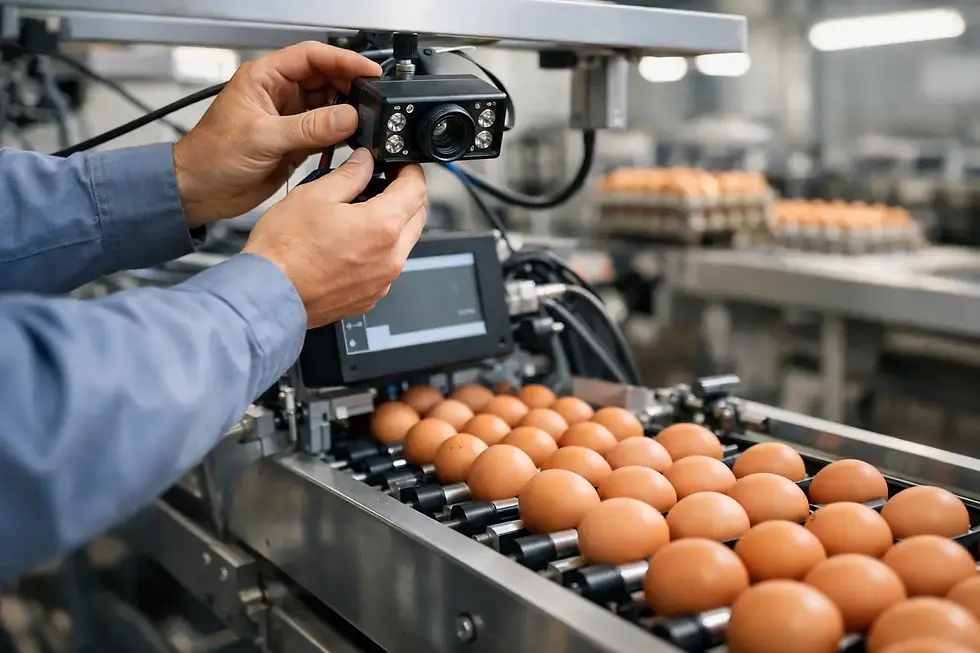
When a belt is moving continuously and eggs are arriving unevenly, bad numbers usually come from one place - poor detection at the point of transfer. Egg production monitoring systems are only useful if they count accurately under real farm conditions, not just in a clean test setup. For commercial producers, the job is straightforward: record every egg, keep the line moving, and give management reliable output data without adding labour.
What egg production monitoring systems need to do
In a commercial house, monitoring starts with counting. If the count is wrong, every report downstream is compromised. Flock performance, belt section comparisons, grading expectations, packing schedules and labour planning all depend on knowing how many eggs are actually coming off the system.
That sounds simple, but the counting point is a demanding environment. Eggs may travel close together, roll slightly on the belt, approach sensors at different angles, or arrive across varying conveyor widths. Dust, vibration and routine wash-down requirements also affect equipment choice. A monitoring system has to work within those conditions without slowing the conveyor or requiring constant adjustment.
For that reason, the core of most practical egg production monitoring systems is not software. It is dependable hardware installed at the right point on the collection line. The software layer can record, display and analyse, but first the system needs a clean, repeatable pulse for each egg counted.
Why the counting method matters
Not all sensing methods perform equally on egg belts. A system built for general object detection may struggle when eggs are clustered or when the product profile changes across the belt width. In poultry production, that usually leads to under-counting, double-counting or drift over the course of a shift.
A purpose-built infra-red counting system is typically the better fit because it is designed around the shape, spacing and movement of eggs. Two-dimensional infra-red counting is especially useful where eggs can appear across the full width of a conveyor rather than in a single narrow line. Instead of assuming neat spacing, it reads the real movement pattern on the belt.
This matters more as throughput increases. At low volume, staff may catch an obvious discrepancy by eye. At commercial scale, small percentage errors become large daily variances. If a unit is handling tens of thousands of eggs, even a modest counting error can distort production records enough to affect flock assessment and planning.
Egg production monitoring systems on conveyors and collection belts
Most buyers are not looking for a general monitoring platform. They are looking for equipment that fits existing belts and conveyors, operates with existing controls, and provides a count output that can be used elsewhere in the system. That is why physical compatibility is one of the first things to check.
Conveyor width is the obvious starting point. Narrow belts may suit a compact counter, while wider collection lines need a model designed to read the full transfer area. If the sensing area is too narrow, eggs at the belt edge may not be counted consistently. If the unit is oversized for the application, installation can become awkward without adding value.
Mounting position also matters. Counters need to be installed where egg flow is stable enough for clear detection. A poor mounting location can create avoidable problems, especially where eggs are still bunching or changing direction. The right installation point is usually dictated by the line layout, transfer behaviour and available support structure rather than convenience alone.
Electrical integration is the next practical issue. Production managers and integrators typically want a clear per-egg pulse output that can feed into existing farm management or control systems. A clean pulse signal is easier to work with than a closed, black-box arrangement because it allows the count to be recorded, displayed or transmitted by the farm's preferred hardware.
Accuracy is not only about the sensor
Producers often ask for an accuracy figure, and that is reasonable, but the number on its own does not tell the full story. Count performance depends on how the equipment is matched to the conveyor width, how it is installed, and whether the egg flow pattern falls within the operating range the device was designed for.
That is why specification and installation guidance should be considered together. A patented counting principle or high-quality sensing head is valuable, but only if it is deployed correctly. On a commercial unit, the practical question is not whether a counter can detect eggs in principle. It is whether it can keep doing so on the actual belt, at the actual speed, over an extended production period.
Maintenance teams usually prefer systems with stable alignment requirements and straightforward electrical connections. If a counter is overly sensitive to minor movement or needs frequent recalibration, the real operating cost increases quickly. Reliable monitoring equipment should support routine production rather than create another daily check.
Choosing between narrow and wide-belt systems
There is no single correct counter format for every site. It depends on the conveyor geometry and where the producer wants to capture the count. Some operations count earlier on narrower belts coming from individual sections. Others count later where product has merged onto a wider conveyor.
A narrower counter can make sense where section-by-section visibility is needed and the line architecture supports multiple count points. That gives more granular production data, but it also increases the number of devices in service. A wider counter installed further downstream reduces hardware count, though it may sacrifice some flock or house-level detail.
This is one of the main trade-offs in egg production monitoring systems. More count points usually mean better diagnostic visibility. Fewer count points mean simpler installation and lower hardware complexity. The right decision depends on whether management needs detailed local data or only a reliable total from the main line.
What buyers should assess before specifying a system
For most commercial sites, the evaluation should start with the line itself rather than the brochure. Measure the conveyor width properly, confirm belt speed, review available mounting positions, and identify where a count pulse needs to go. Those details determine whether a unit will integrate cleanly.
It is also worth checking how the equipment handles pulse output, power requirements and physical clearances. In an existing house, space around the conveyor is often tighter than expected. A counter that looks simple on paper may require brackets, guards or cable routing changes to fit safely.
Suppliers with a narrow focus on egg counting equipment tend to be more useful here than general sensor vendors. They are more likely to understand common belt layouts, transfer issues and the effect of egg presentation on count quality. Agro System, for example, has built its range around defined conveyor widths and per-egg pulse output, which is the sort of application-specific approach most producers need.
Where monitoring data becomes useful
Once accurate count data is available, it can feed several practical decisions. Production managers can compare expected and actual output by house, shift or line. Packing and grading teams can see incoming volume earlier. Maintenance leads can spot flow interruptions or irregular line behaviour when counts deviate from normal patterns.
The value is operational rather than abstract. Better count data helps identify whether an issue is with the birds, the collection process or downstream handling. Without confidence in the basic egg count, that diagnosis becomes guesswork.
That said, not every site needs a complex data layer. Some only need a dependable hardware count linked into an existing controller or display. Others want the count integrated into wider farm management reporting. Neither approach is inherently better. The key is that the counting equipment supplies a reliable signal the farm can trust.
Common mistakes when implementing egg production monitoring systems
One common mistake is treating the counter as a generic accessory. Egg counting is a specific application, and the equipment should be selected accordingly. Another is choosing on nominal capacity alone without considering belt width and egg distribution across the conveyor.
Poor installation planning is another issue. A high-quality counter can still perform badly if mounted where eggs are unstable or where the sensing zone is partially obstructed. Sites also run into problems when the count output is specified too late, after the electrical integration has already been planned around unsuitable inputs.
Finally, some operations expect monitoring equipment to correct process problems it can only reveal. A counter can show that output is lower than expected or that line flow is inconsistent, but it cannot fix mechanical handling faults upstream. Monitoring works best when it is part of a disciplined production system, not a substitute for one.
For commercial producers, that is the useful way to look at egg production monitoring systems. Start with accurate counting on the belt, match the device to the conveyor, install it properly, and make sure the output is usable in the wider operation. If the count can be trusted, better decisions usually follow.


Comments