


How to Reduce Manual Egg Tallying
- bay7962
- Apr 26
- 6 min read
If staff are still writing tray counts on a clipboard at the end of each shift, the problem is not only labour. It is delay, avoidable counting error, and weak production visibility. For commercial sites running collection belts and conveyors, how to reduce manual egg tallying comes down to one thing: counting eggs automatically at the point where they already move through the system.
Manual tallying tends to survive because it looks simple. A member of staff checks stack counts, estimates losses, and enters totals later. That may be workable at small scale, but it becomes unreliable once volume increases, belt speeds vary, or eggs from multiple lines merge into one flow. By then, the count is no longer a clean operational figure. It is a reconstructed estimate.
Why manual tallying creates production blind spots
The main weakness in manual methods is not that people cannot count. It is that the eggs are counted after handling, after transfer, or after batching, rather than at the moment they pass through the collection system. Every extra step creates room for discrepancy.
Breakages can occur between the belt and the packing point. Trays can be misread. Shift handovers can duplicate or miss figures. If a flock section underperforms for two hours, a manual process may not show that until the end of the day, when the chance to investigate has already passed.
For farm managers and production leads, that affects more than reporting. Feed conversion review, flock monitoring, labour planning, and grading comparisons all depend on count accuracy. A weak count means weaker decisions.
How to reduce manual egg tallying at the source
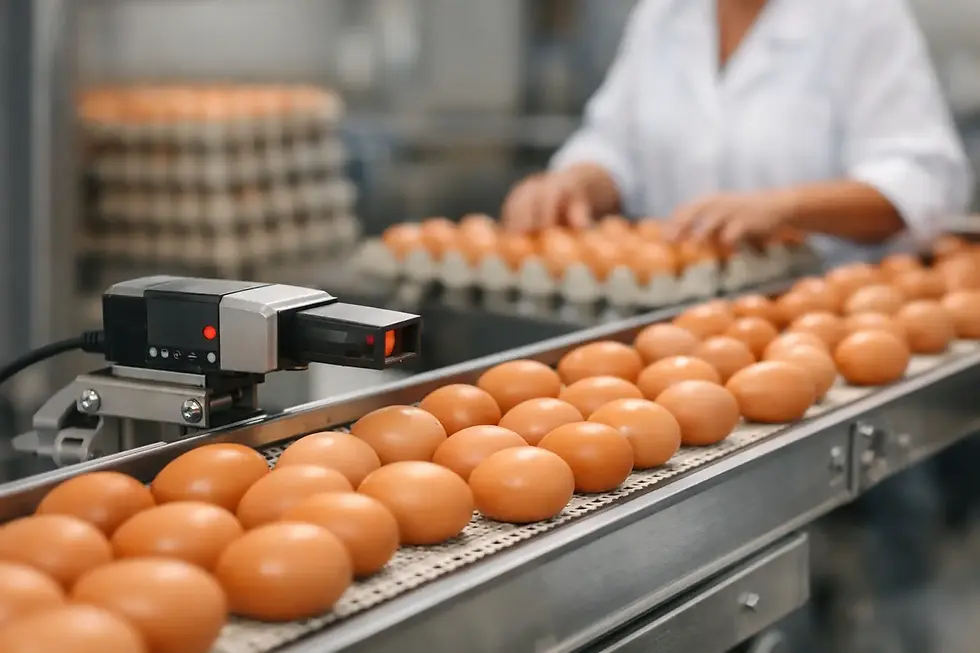
The most effective answer is to replace batch estimation with inline egg counting. In practical terms, that means installing a dedicated egg counter on the egg belt or conveyor so each egg is registered as it passes the sensing point.
This approach removes the need for operators to total trays, reconcile partial stacks, or estimate output from belt loading. Instead, the line generates a count pulse per egg. That output can then be sent to the farm management system, display unit, PLC, or another recording device already used on site.
The benefit is straightforward. You are no longer asking staff to create the number manually. The system produces the number directly from egg flow.
Count where eggs travel naturally
The best installations do not interrupt the process. Eggs remain on the existing collection belt or conveyor, and the counter is fitted to suit the belt width and layout. That matters because any counting method that requires handling, singulation outside the main line, or manual loading creates another labour point.
A two-dimensional infra-red counting system is typically better suited to production environments than improvised sensor arrangements because it is designed to detect eggs moving in normal flow across a belt. That reduces dependence on perfect spacing and helps maintain line throughput.
Match the counter to conveyor width
Sizing matters. A counter built for a narrow belt is not the right choice for a wide conveyor carrying a broader product spread. Commercial operations should select equipment that matches the actual belt width and installation conditions, whether that is a 10 cm line or a wider conveyor format.
This is where some projects fail. Operators try to solve a counting problem with a generic sensor package that was not designed for egg collection infrastructure. It may work in a controlled test, then lose accuracy once belt loading changes, shells vary, dust builds up, or the line runs at production pace.
Automation does not remove installation discipline
Reducing manual tallying does not mean any counter will perform well in any position. Accurate automatic counting still depends on correct placement, stable mounting, clean wiring, and proper alignment with product flow.
If the sensor head is poorly positioned, eggs may be counted inconsistently at the belt edge or where product clusters form. If the mounting allows vibration, signal quality can suffer. If the output pulse is not configured correctly for the receiving system, the count may be right at the device but wrong in the record.
That is why installation guidance is part of the solution, not an extra. A production-grade egg counter should be installed with attention to conveyor width, egg traffic pattern, belt condition, and downstream data handling.
Data quality improves when labour is removed from the count
Manual tallying usually mixes observation with administration. Someone watches the output, records a figure, transfers it later, and then another person may enter it into a spreadsheet or flock system. Every one of those steps introduces delay.
Automatic counting shortens that chain. A per-egg pulse output can feed directly into the device or control environment used to monitor production. That means fewer transcription errors and fewer disputes over whether the issue came from the belt, the record, or the shift log.
It also gives managers a count they can use during the day rather than after the fact. If output from one row drops unexpectedly, the problem can be investigated while birds, belts, and collection equipment are still in operating condition.
Real-time visibility changes response time
This is one of the practical gains that often gets overlooked. The purpose is not only to save labour on counting. It is to improve response.
When counts are visible in real time or near real time, staff can spot interruptions, uneven line loading, or performance differences between houses sooner. That does not eliminate the need for production judgement, but it gives that judgement a firmer base.
Where manual tallying may still remain
There are cases where some manual check remains sensible. During commissioning, many sites verify automatic counts against physical samples to confirm the installation is performing as expected. That is good practice.
Some operations also keep manual reconciliation for exception handling, such as unusual breakage events, maintenance stoppages, or temporary routing changes. The point is not that all manual recording disappears overnight. The point is that manual tallying stops being the primary counting method.
That distinction matters. Verification is useful. Dependence is expensive.
Choosing equipment for a commercial egg room
If the goal is how to reduce manual egg tallying in a serious production environment, the equipment needs to be purpose-built for eggs, not adapted from a general parts-counting application. Eggs vary in spacing, shell appearance, and movement pattern. The counter has to deal with that reality without slowing the line.
Look for a system designed specifically for egg belts and conveyors, with a defined conveyor width range, stable pulse output, and clear installation requirements. Precision claims should relate to actual operating conditions, not ideal bench tests.
A narrow product focus is often an advantage here. Specialist egg-counting hardware is more likely to account for the details that affect real accuracy, including sensor geometry, belt presentation, and line integration. Agro System, for example, centres its equipment around this exact task rather than treating egg counting as a minor add-on.
Process changes that support automatic counting
Technology does most of the work, but process still matters. If belts are poorly maintained, eggs bunch heavily before the counting point, or operators routinely change flow without recording it, even a good counter will be harder to use well.
A sensible upgrade usually includes three practical adjustments. First, define a fixed counting location on each line. Second, make sure the receiving system for the count pulse is known and tested. Third, train staff on what the automated count represents so they stop rebuilding totals manually out of habit.
That last point is more important than it sounds. On many sites, staff continue manual logs because that is how the farm has always reconciled output. Once the automatic count proves stable, those duplicate steps should be reduced. Otherwise the site pays for automation while still carrying manual admin.
The real return is operational control
Labour saving is the obvious gain, but it is not the only one. Better counts support flock analysis, improve confidence in daily output reporting, and reduce the time spent arguing over numbers that should have been clear from the start.
For commercial producers, the most reliable path is usually straightforward: count eggs on the belt, use equipment matched to the conveyor, install it properly, and send the count directly into the system that manages production records. That is how manual tallying stops being part of the workflow rather than just a smaller part of the paperwork.
The useful question is not whether staff can keep counting by hand for another season. It is whether the current method gives you a number you can trust when the line is running at full pace.


Comments