


How to Retrofit Egg Counting Equipment
- bay7962
- 19 hours ago
- 6 min read
Retrofitting a working egg room is rarely about adding one more device. It is about improving count accuracy without slowing belts, altering egg flow, or creating a maintenance problem somewhere else on the line. If you are looking at how to retrofit egg counting equipment, the real job is to match the counter to the conveyor, the electrical system, and the production conditions already in place.
In most houses, the retrofit question starts when manual tallies no longer match actual output, when a packer feed line has changed, or when older counting hardware is missing eggs at higher volumes. A good retrofit fixes that without forcing a rebuild of the collection system. That is why the first step is not choosing a model. It is defining exactly what the existing line is doing.
Start with the conveyor, not the counter
An egg counter only performs as well as the belt presentation allows. Before specifying equipment, check the belt width, belt speed, egg density on the belt, side guides, vibration, transfer points and any areas where eggs bunch or overlap. Two lines with the same nominal width can behave very differently if one has steady spacing and the other runs with uneven flow from upstream collection.
Measure the usable counting width rather than relying on a brochure dimension for the conveyor. Frames, covers and guide rails often reduce the true window available for mounting. If the retrofit is going onto a narrow belt, a compact counter body may be enough. On broader conveyors, sensor coverage across the full width becomes the main issue. A mismatch here is one of the most common reasons retrofits underperform.
You also need to decide where the count matters. Some producers want a count per house, others at a central collection point, and some at transfer conveyors before grading. The correct location depends on whether you are tracking bird performance, belt output, or packer feed volume. Retrofitting at the wrong point can give accurate numbers that are still not useful operationally.
How to retrofit egg counting equipment without disturbing flow
The best retrofit positions the counter where eggs are stable, singulated as far as practical, and travelling at a consistent speed. Straight belt sections are generally preferable to transitions, inclines or areas immediately after drops. If eggs are bouncing, rotating heavily, or crowding against one side, the counting head will be working harder than it should.
This is also where retrofit discipline matters. Do not treat the counter as a bolt-on accessory. Mounting height, alignment and rigidity affect performance directly. A counting unit fixed to a flimsy bracket can drift out of position through normal vibration. In a commercial environment, small shifts become count errors over time.
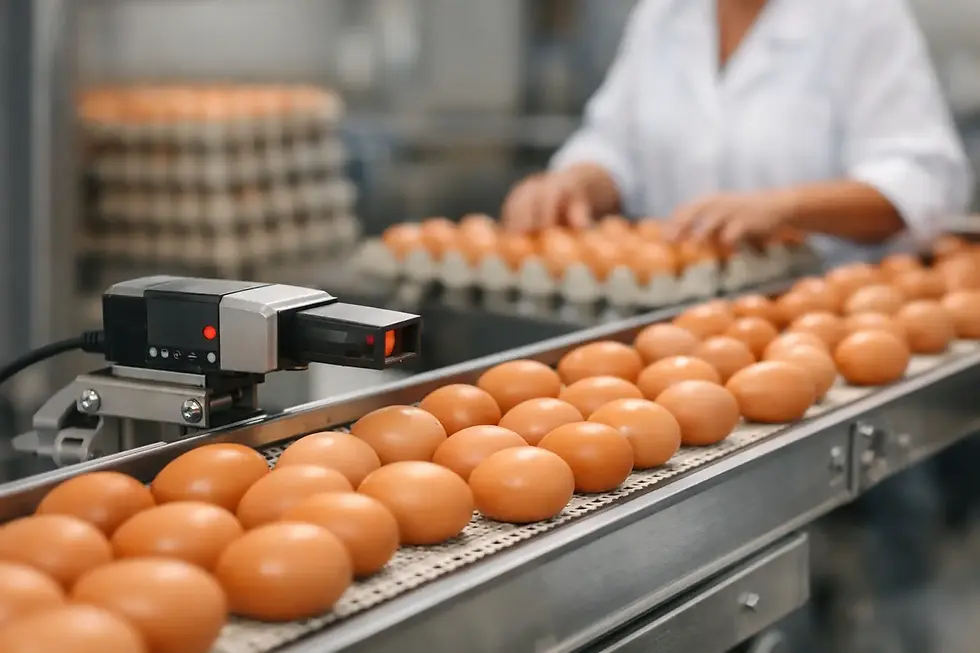
For infra-red counting systems, keep the sensing area clear of obstructions and avoid makeshift guards that intrude into the detection zone. If line protection is needed, it has to be designed around the counting geometry, not added afterwards with whatever material is available in the workshop.
Electrical integration should be planned at the same time as the mechanical fit. If the counter provides a per-egg pulse output, confirm that the receiving PLC, monitor or farm management input can accept the signal properly. Pulse timing, input type and cable routing all matter. A mechanically correct installation can still fail operationally if the control side misses pulses or introduces electrical noise.
Choosing the right counter size for a retrofit
Retrofit success depends heavily on choosing equipment built for the belt width you actually have. Narrow collection belts need a different form factor from broad transfer conveyors. This sounds obvious, but many retrofits fail because buyers try to adapt a unit meant for one width range onto another conveyor simply because mounting holes can be made to fit.
On a 10 cm belt, the physical footprint and sensing field need to suit a narrow presentation. On 20 cm to 100 cm conveyors, coverage across the full width becomes the priority, along with maintaining consistent detection across all lanes of travel on the belt. If your facility has mixed line widths, standardising every location around one model may simplify spares, but it is not always the best technical choice.
This is where purpose-built equipment has an advantage. A specialised range such as the Accucount Mark 5 for narrow belts and the Accucount N series for wider conveyors allows the retrofit to match the line rather than forcing the line to suit the device. That reduces bracket fabrication, improvised shielding and the other changes that add cost without improving count quality.
Mechanical checks that matter in the field
When retrofitting, the practical details usually decide whether the installation stays accurate after six months. Bracket stiffness, service access and cleaning clearance are more important than they look on day one. If maintenance staff cannot inspect or wipe the sensor area easily, performance will drift.
Keep the mount adjustable enough for final alignment, but not so adjustable that it can move accidentally. Once the correct position is set, it should stay set. Use mounting points that are part of the machine structure rather than light sheet covers wherever possible.
Look at environmental exposure as well. Dust, feather debris and wash-down practices vary by site. If the counter is being fitted into a house or room with routine moisture exposure, cable entries and enclosures need to suit that environment. Retrofitting precision equipment into a wet or contaminated area without protecting the installation simply shifts the problem from counting accuracy to downtime.
Control integration and signal handling
In retrofit work, the phrase accurate counting often gets narrowed down to the sensor head alone. In reality, the output chain matters just as much. If each egg produces a pulse, that pulse has to be captured reliably by whatever device is recording production. Check supply voltage, current requirements, pulse duration and input compatibility before installation begins.
If the existing control system is old, do not assume it will accept a modern pulse signal cleanly. Some sites need an interface relay, conditioner or revised input configuration. Others can wire directly with no issue. It depends on the control hardware, cable lengths and electrical environment around motors and drives.
Route signal cables away from heavy power circuits where possible. Good counting equipment can still appear inconsistent if interference is introduced by poor cable management. For the same reason, make sure earthing is correct and documented. A retrofit should leave the site easier to troubleshoot, not harder.
Testing a retrofit properly
Once fitted, the counter needs to be tested under real operating conditions, not only at slow speed with a handful of eggs. Run the line at normal production rate and compare the recorded count against a physical verification method over a meaningful sample. Short checks are useful for confirming basic function, but they do not always reveal missed counts caused by crowding, belt vibration or uneven feed.
Test during the conditions that usually create problems. That may be peak lay periods, higher line loading, or a specific transfer point where eggs arrive in clusters. If the counter performs only when the line is running gently, the retrofit is not complete.
It is also worth checking the installation after the first period of operation. Brackets settle, operators clean around the unit, and cable ties get moved during unrelated maintenance. A scheduled recheck catches those small changes before they become a production argument about whether the count can be trusted.
When a retrofit is straightforward and when it is not
Some installations are simple. A straight belt, stable egg flow, suitable power supply and compatible control input usually mean the job is mainly about correct sizing and clean mounting. Other sites are less cooperative. Multi-stage transfers, excessive belt vibration, irregular side loading or limited mounting space can make a retrofit more involved.
That does not always mean replacing the conveyor. In many cases, a small change upstream such as improving egg presentation or relocating the count point gives a better result than forcing the sensor into a poor location. The trade-off is that the best counting point is not always the easiest place to mount equipment.
If you are comparing options, focus less on generic automation language and more on fit for the actual belt width, signal output, installation geometry and field serviceability. Egg counting is a narrow application. It rewards specialised hardware and careful placement more than broad feature lists.
A retrofit earns its keep when the count becomes dependable enough that staff stop checking it by hand. That is the practical standard. If the equipment fits the conveyor, the signal fits the control system, and the installation respects the way eggs really move on the belt, the result is not complicated. It is simply accurate, repeatable production data you can use.


Comments