


7 Commercial Egg Counter Benefits
- bay7962
- Jun 3
- 6 min read
The value of commercial egg counter benefits shows up fastest when counts stop matching trays, belt flow varies across the house, or production data arrives too late to be useful. On a modern egg line, guessing is expensive. If the count at the collection point is wrong, every number that follows - yield, flock performance, labour planning and dispatch expectations - is built on a weak base.
A commercial egg counter is not just a convenience for a large unit. It is a control point. In operations running automatic egg collection belts and conveyors, accurate counting provides a live record of what is moving through the system without slowing production or adding manual checking. That matters whether the aim is tighter daily reporting, better flock comparison or clearer fault finding when output changes.
Why commercial egg counter benefits matter on a working line
In a commercial house, eggs do not arrive in neat manual batches. They move continuously, often at different speeds, over belts and transfer points that already carry enough mechanical and management pressure. Counting by hand, estimating by tray totals or relying on occasional spot checks creates delay and introduces avoidable error.
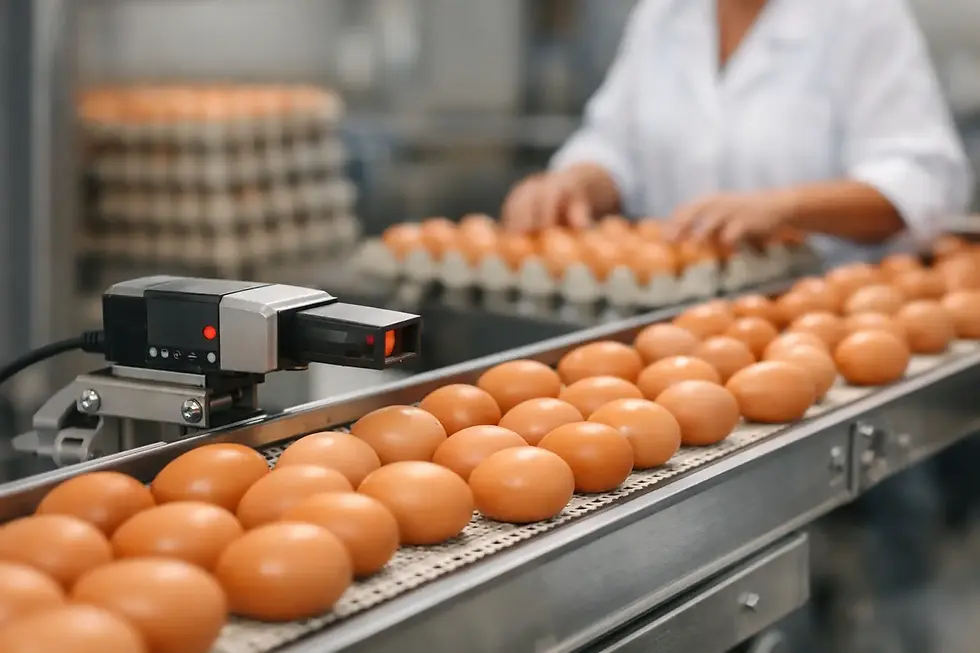
The main commercial egg counter benefits come from replacing approximation with per-egg measurement. A dedicated infra-red counter fitted correctly to the belt line can register each egg as it passes, producing a precise pulse output for monitoring and control. That gives the production team a count they can use with confidence, rather than a number that needs checking later.
The gain is not only accuracy. It is consistency. A stable count at the conveyor allows managers to compare houses, assess bird performance and identify abnormal changes earlier in the day, not after paperwork is finished.
Better production visibility without manual counting
The first practical advantage is immediate visibility. When eggs are counted automatically on the collection belt, the production team can see what a house is producing while the line is running. That is a very different situation from waiting for tray or pack totals to be compiled afterwards.
For a farm manager, this means output can be tracked by house, row or conveyor section depending on how the system is arranged. For a maintenance lead, it becomes easier to notice when a belt is underperforming, when flow has changed, or when an upstream issue may be affecting delivery.
Manual counting still has a place for verification, but it is poorly suited to high-volume routine measurement. It takes time, pulls labour away from other tasks and usually appears after the point where corrective action would have helped. Automatic counting shifts the information earlier in the process, where it is more useful.
Higher counting accuracy on belts and conveyors
Accuracy is the reason most producers start looking at counters in the first place. In commercial conditions, the challenge is not simply seeing eggs pass one point. It is counting reliably across moving belts, varying conveyor widths and changing line conditions without double counts or missed counts becoming a pattern.
This is where purpose-built equipment matters. A system designed specifically for egg flow on commercial conveyors is built around the physical realities of poultry handling. Sensor geometry, pulse output and mounting position all influence whether the recorded total reflects actual throughput.
Not every operation needs the same counter format. Narrow belts and wider conveyor sections create different installation requirements, so sizing needs to match the line. A unit chosen for the actual belt width and fitted properly will usually deliver better results than a generic sensor arrangement adapted later. That sounds obvious, but many counting problems start with poor fit rather than poor electronics.
Lower labour demand and fewer routine checks
Another of the clearest commercial egg counter benefits is reduced reliance on repetitive manual labour. Counting eggs by hand, checking transfer totals and reconciling differences between expected and actual output all consume staff time that could be used elsewhere in the house or packing area.
An automatic counter does not remove the need for supervision, but it cuts out a low-value task that becomes less practical as volume rises. In large operations, even a small amount of daily counting time per line adds up across houses and weeks. The labour saving is not just the minutes spent counting. It includes the time spent correcting avoidable recording errors and investigating totals that never had a reliable starting point.
There is also a quality benefit in removing fatigue from the count process. People get distracted. Production lines do not pause because somebody is called away. A fixed counter continues registering eggs under the same set conditions throughout the run.
Stronger flock performance analysis
Accurate counts support better flock management because they improve the quality of the data behind daily decisions. If the count at collection is dependable, production can be compared more confidently against bird age, feed intake, lighting programme and house conditions.
This helps when performance shifts are small but meaningful. A gradual decline, a difference between otherwise similar houses, or an unexplained production gap becomes easier to identify when the count itself is not in doubt. The sooner those changes are visible, the sooner the team can check causes and respond.
For producers managing multiple houses, this matters even more. Comparing one flock against another only works if the numbers are measured the same way. Automatic counting creates that consistency. Without it, one house may appear to perform differently simply because the recording method is weaker.
Easier integration with control and monitoring systems
A commercial egg counter becomes more useful when it does not operate in isolation. In many production environments, the count signal is used as part of a wider monitoring arrangement, feeding totals into management software, display units or local control systems.
Per-egg pulse output is particularly useful here because it gives a direct, measurable signal tied to actual egg movement. For integrators and equipment buyers, that matters more than a vague total on a standalone display. It allows the count to be captured, recorded and used elsewhere in the farm's reporting structure.
The detail of integration depends on the site. Some farms want simple local totals. Others want counts brought into a broader production management setup. The practical point is that a dedicated counter can support both, provided the electrical and installation requirements are understood from the start.
Better fault finding when production numbers change
When output drops unexpectedly, the first question is whether production is actually down or whether the recording is wrong. If the count source is unreliable, troubleshooting becomes slower and more expensive because the team is chasing both possibilities at once.
A dependable counter narrows the problem. If birds are producing less, the count confirms it. If belt movement or transfer behaviour changes, the count pattern may show where to look. If downstream handling totals do not match collection figures, the discrepancy can be investigated with a firmer reference point.
This is one of the less obvious commercial egg counter benefits, but on a busy site it has real value. Better diagnostics reduce wasted time. They also reduce the tendency to compensate with extra manual checks, which often create more delay than clarity.
Scalability across different conveyor widths
Commercial egg operations are rarely identical from one site to the next. Conveyor widths differ, line layouts vary and expansion often happens in stages. That makes scalability an important buying factor.
A counter range that covers narrow and wide conveyors is easier to standardise across a business than a one-size-fits-all device. It allows the same counting principle to be applied in different parts of the operation while matching the physical width of each belt. That improves compatibility and keeps installation more straightforward.
For buyers specifying equipment for new builds or upgrades, this flexibility matters. The right solution is not always the most complex one. It is the one that fits the conveyor correctly, produces a clean count signal and holds accuracy under normal operating conditions. Agro System's specialist approach reflects that reality by focusing on counting equipment built specifically for production egg lines rather than general-purpose sensing.
The trade-off: good results depend on correct installation
No technical article on this subject should pretend that the device alone guarantees performance. Counting accuracy depends on proper positioning, suitable belt conditions, correct electrical setup and selection of the right model for the conveyor width.
If installation is poor, even good equipment can give poor data. Misalignment, unstable mounting or unsuitable placement near problematic transfers can all affect results. That is why installation guidance is not an extra. It is part of the counting system.
For the buyer, the lesson is simple. Evaluate the line first. Measure the conveyor width accurately. Confirm power requirements and signal handling. Make sure the counter is being used in the application it was designed for. Most counting problems are easier to avoid at specification stage than to solve after commissioning.
A commercial egg counter earns its place when it turns egg movement into dependable production information. If the count is accurate, timely and matched to the conveyor, the rest of the operation can make better decisions with less effort. That is usually where the return starts - not in the sensor itself, but in the quality of the numbers the farm relies on every day.


Comments